The post Get God Involved in the Writing Process appeared first on The Anointed Editorial.
]]>Christian writers are people chosen by God to communicate His heart to His people.
2 Timothy 3:16 says that all Scripture is inspired by God. For Christian writers, God is our lifeline for divine wisdom and revelation. He trusts us to seek Him whenever we put pen to paper (or cursor to Word doc) and to write what he instructs.
Even for the most powerful writer, it can be difficult to remain God-centered during designated times of writing. Careers, families, chores, and our lives call out for priority constantly. That is why the purpose of this article is to help Christian authors remain aligned with the heartbeat of heaven: God’s heart.
4 Ways to Invite God into the Writing Process
God is always speaking and if we take the time to listen, we can hear what He is saying. Whether that be through audible words from the Holy Spirit or gentle nudges to go in a certain direction, Christian writers are expected to pay attention to these experiences and turn them into written words to be accepted by others. There are several ways to ensure that God is invited into every part of the writing process, but for now, let’s discuss four.
Praying
I’ve heard it said that “prayer is always in order,” and there’s no better time to seek God than when choosing to write to and for Christian audiences. Beginning any time of writing in this way helps us focus our minds on what matters — understanding what God wants to say. Intentional prayer is our attempt to still the world around us and commune with that part of us that connects with Him. And God isn’t looking for long-winded, fanciful prayers. It’s okay to simply acknowledge that every word we write comes from God and is inspired by Him. We can also make declarations over what we expect the outcome of our writing session to be.
Journaling
I attended several writing camps as a girl. In different locations, while focused on developing different writing skills, each camp instructor understood the importance of writing sprints.
Journaling, specifically to God, reminds me of those writing sprints. This activity can serve as a way to get more in tune with Him while knocking those creative screws in the brain loose. Set a timer for seven-to-ten minutes and let the unadulterated words flow.
Listening to Music
I’ll admit that I never thought God could inhabit “soaking” worship music — that is, until I tried it for myself. Some of my most productive writing sessions have been while I sat listening to soaking music and working. Music that glorifies God invites Him wherever we are when we play it, even while we write.
“Bringing to Your Remembrance” (John 14:26)
The mind is quite an organ. Many Scriptures discuss how powerful our thoughts are. Therefore, a few moments of intentional, grateful reflection can open our minds to more divine revelation. We can think about what God has done for us, and how He wants to use us in this specific area through book writing. We can start the writing session with a renewed sense of purpose. This method can be combined with one of the other methods mentioned above or one of your own.
I’m sure you’ll eventually want to start writing, so don’t plan to spend a lot of time on your warm up. While it’s important to stretch, much like a runner before a leg workout, you don’t want to stay there. I’d recommend doing one or two exercises at any designated writing time, but no more. Once you’ve connected with God, let your words flow!
Featured photo by Amaury Gutierrez on Unsplash
The post Get God Involved in the Writing Process appeared first on The Anointed Editorial.
]]>The post ChatGPT for Christian Writers? appeared first on The Anointed Editorial.
]]>Using artificial intelligence to write Christian content or any content can have polarizing views.
There’s one word you dare not speak around me: AI. ChatGPT. (I guess that’s two.)
Since the introduction of ChatGPT in November 2022, I’ve avoided it at all costs. I read the stories: how easily the tool scoured the internet and plagiarized sources. How void of voice the writing it developed seemed.
But I heard stories of its triumphs — an old college associate (who is a boss when it comes to helping business owners secure business credit, btw) used it to come up with a week-long meal plan or how it put together a somewhat decent email blast for a client.
I hadn’t heard much about ChatGPT’s usage in the realm of Christian writing, though. So I decided to put it to the test. I prompted the AI to write three articles about a Christian-based topic for me, varied by how specific I was about what I wanted the technology to write.
To start, I provided ChatGPT with what I consider a vague topic. I asked the software to write an article about the Holy Spirit. I did this twice and showcased my voice through two different articles: this article from my website and the other from my featured content on the Follower of One website.

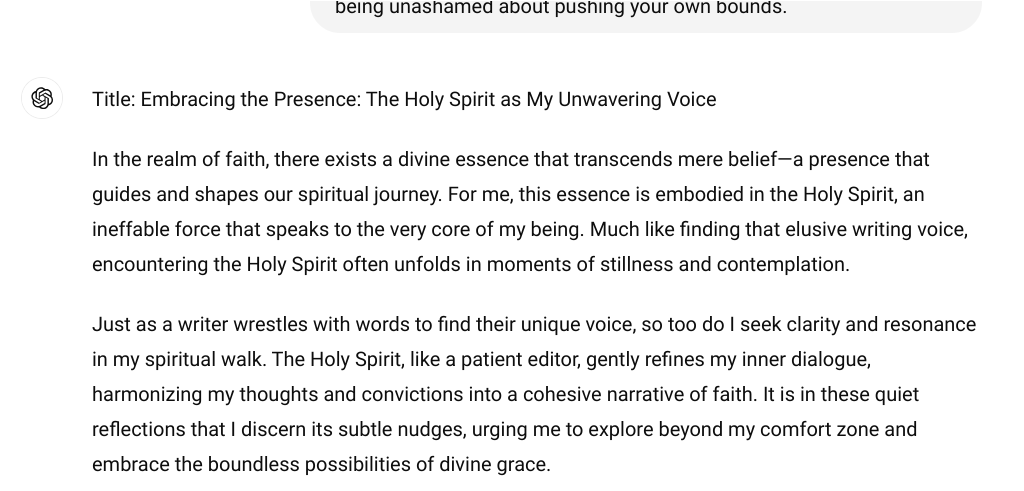
Because what I gave ChatGPT to work with was so vague, it tried to use the content I provided as a guide, literally lifting lines from my writing and rephrasing. When I used the article from the Follower of One website, the AI still included content about the Holy Spirit through the process of writing and editing, which would have come from the article on my website (I used that article first). This showed me that the software was attempting to learn my voice and incorporate it into the writing.
I thought that using the Follower of One article yielded results closer to what I had in mind, so I used it again when giving ChatGPT a new prompt. This time, I told it to write an article about five reasons why you need the Holy Spirit.

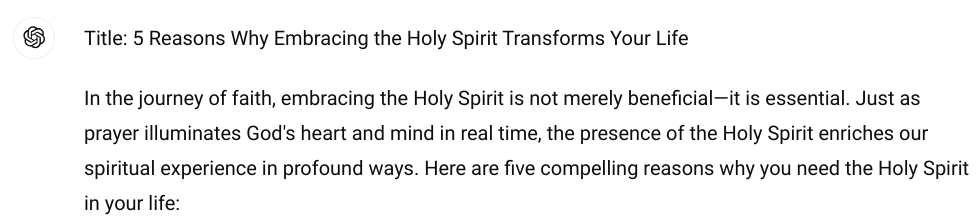
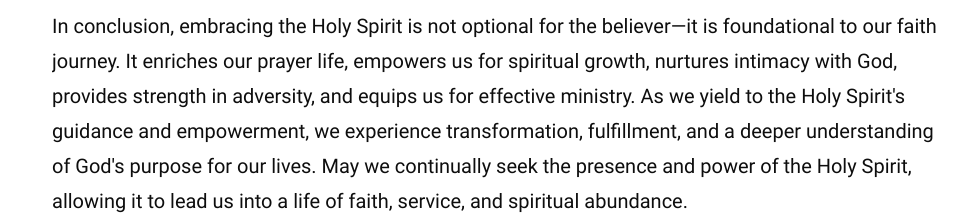
Again, I could tell the AI was learning my voice and my writing style. The article created hit the mark as far as including a five-point list, but I found it wanting in the conclusion department. It read like something my fifth grader would write; in other words, it was very elementary in its recap of all the previous points provided.
For my last party trick, I tried to be as specific as possible. I gave the technology my most targeted request. I told ChatGPT to write a 10,000-word essay explaining what the Holy Spirit is, why a person needs it, and how someone might go about receiving the Holy Spirit.

ChatGPT did not produce an essay for me but provided an outline of how to write such an ambitious article. While impressed with the outline, the technology did not actually fulfill my request.

I doubled back and told ChatGPT to write a 1,000-word essay instead while outlining the same parameters. An essay was generated; however, it was not 1,000 words but instead a little over 600. I also noticed that my specificity caused the AI to spit out an article with no voice. It was a regurgitation of information.

I must say that ChatGPT surprised me in some unsuspecting ways. Now does this experience make me want to advocate for regular use of ChatGPT or any AI technology for writing? No. But I can recognize and honor the appeal.
Christian writers should be especially careful about using AI to create most of their content. As Christian authors, our main source of inspiration should be the Holy Spirit. It will tell us what to write and how to write it. Reliance on any other source leads us away from God and the hearts and minds He’d like us to impact.
I know this article may sway some from using this technology altogether while it might just light the fuse for others. If you’re in the latter group, there are some dos and don’ts for using AI like this that I want to share.
Dos and Don’ts for Using Artificial Intelligence
Do
Create an account
This will allow you to keep track of the ways you’ve used AI and helps AI make a note of your writing preferences.
Double-check for plagiarized work and made-up facts
As you may have noticed in one of the above images, the makers of ChatGPT acknowledge that the technology can make mistakes. We should do our due diligence to make sure we’re not on the receiving end of a lawsuit by checking all the facts any AI presents as true.
Edit/Proofread anything created by AI
Remember to edit and proofread anything created by any AI to ensure it represents your voice and writing style and that the text is grammatically correct.
Don’t
Rely on AI to write everything for you
A tool like ChatGPT is not meant to do all the work for you. If you’re a person who might rely heavily on technology to write, it could become a crutch to you and limit your ability to work out your own writing muscles.
Attempt to pass AI-generated work off as your own
This tip goes in line with making sure all the content AI gives you is original. Imagine having AI write a book for you and you publish it only to find that a substantial amount was lifted from other sources. Yeah, that probably won’t go over well. Additionally, some social media sites are requiring that you put a label on any of your content created with AI.
Use AI
I’ll probably take this stance forever. Just don’t use AI.
Though I hold sacred the art of writing, I believe that AI is not (always) our enemy. When harnessed properly, it can be beneficial to a Christian author or someone who is not a strong writer. There are observances that every user should make when utilizing these powerful tools.
The post ChatGPT for Christian Writers? appeared first on The Anointed Editorial.
]]>The post Finding the Right Tone for Your Christian Nonfiction Book appeared first on The Anointed Editorial.
]]>Writing tone is an afterthought when writing a book, but it influences how readers connect with your work.
The tone you choose to take in your writing influences the type of writing you produce. For many authors, they know that they know all the things, and they believe this knowledge should be shared, but they never consider in what way to convey the message. The good news is there are many ways to do so. In this article, I’d like to provide a few pointers for finding the best tone to use in your Christian nonfiction book.
What Kind of Book Are You Writing?
Before you can consider the tone you will write your book in, you need to decide what type of book you want to write. What I mean by this is choosing the appropriate story structure. According to Blurb, story structure is “the order in which you present the narrative.” Story structure is an important part of both fiction and nonfiction, though the presentation may be slightly different in each type of writing.
Commonly used structures include:
- Chronological – a story written following the proper order of events
- Episodic – a collection of stories connected by the same theme or lesson
- Lived experience – a recollection of the author’s lived experience or the experiences of others (anecdotes) to share lessons
- Inciting incident – one event in the author’s life that serves as a launching point for a theme, lesson, or source of deep research
- Foundational concepts – a simple concept that is built on with each chapter
- Prescriptive – instruction or how-to for a new skill
In order to determine story structure for your Christian nonfiction book, you will need to consider what journey you want to take your reader on. What new information will you be sharing with them? What is the transformation promise you’ve given your book as it pertains to how your reader will grow and change? Sometimes this isn’t so cut-and-dry. It’s easy for a book idea to fall into more than one of these categories, and that’s okay. But once this is figured out, you’re on the way to uncovering the right tone for your writing.

Choosing the Right Writing Tone
Your writing tone should not be one that you use for the sake of using. It should feel authentic and flow from the most sincere parts of you. Oftentimes, that writing pizzazz isn’t found until you actually put pen (or typing cursor) to paper. Nonetheless, it’s important to have one clear voice that your reader “hears.” I’ve read and provided feedback on manuscripts where there was more than one writing voice present, and if your editor can pick up on it, your reader can, too. Be sure to carefully consider what’s in your level of comfort while being unashamed about pushing your own bounds. You may find the effort truly rewarding. And if you’re struggling to think about tone for your Christian nonfiction manuscript, the following list includes some of the most used.
Conversational
This book is written in the author’s voice. You may write as if speaking to a friend you converse with on the regular. The manuscript may include some of your special lingo and personality or humor.
Authoritative/Teacher
True subject matter experts may feel most comfortable taking on a voice of authority. You may just want to teach your audience and leave the personality out of it. After all, your expertise is important and should be conveyed in that way.
Inspirational
Inspirational writing might be “getting down on your reader’s level.” You understand how they feel, why they’ve picked up this book, and you are there to offer a metaphorical hand to encourage them to keep going.
“Flowery”
Flowery tones are perhaps most often seen in creative nonfiction books as they take on elements of storytelling similar to those seen in fiction. We all know some fiction books that are heavy on word embellishment, so the language is grandiose and imaginative. You may have some of that flowery language in you.
When deciding on the perfect tone to take in your book, don’t be afraid to play around. An editor, such as a developmental editor, can even help you identify what type of writing tone is your strength once they do a read through of your manuscript. No matter what writing tone you decide on, make it your own and don’t shy away from it. Your readers will be able to better connect with you as the expert.
P.S. – I don’t offer developmental editing at this time, but I do offer a manuscript evaluation, which is similar to a developmental edit. If you’d like to learn more about this service, click here.
Featured photo by Rahul Shah on Pexels; in-text photo by Steve Johnson on Pexels
Reference: Blurb. “What is story structure?”. Date accessed 2/10/2024. https://www.blurb.com/blog/what-is-story-structure/.
The post Finding the Right Tone for Your Christian Nonfiction Book appeared first on The Anointed Editorial.
]]>